
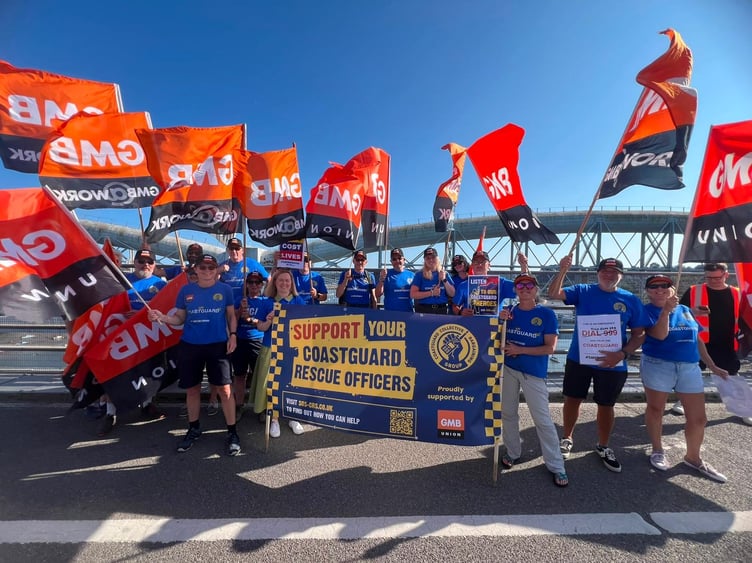
MEMBERS of Devon’s coastguard staged a protest with their Cornish counterparts amid their ongoing battle over pay and their legal status as workers.
Teams from across the two counties met at the middle of the Tamar Bridge as part of efforts to ready themselves for the next chapter in the war over how coastguards are remunerated and their classification.
The Maritime and Coastguard Agency (MCA) had sought to move members of its coastguard rescue teams to an expenses-only volunteer model.
At present, coastguard rescue officers (CROs) are paid an hourly rate when on callouts, but the MCA wanted to scrap those payments so it could classify them as volunteers.
Members of some of Devon’s teams said they feared the move would prompt many to greatly reduce their availability or leave the service altogether.
A spokesperson for the MCA said the organisation had listened to the response to its proposed changes and had agreed a pause so it can do more work to understand the impact of any potential changes.
While CROs are called volunteers, there are formal requirements upon them, such as training, and the payments made to them while on callouts mean they are technically workers.
Furthermore, their lead responsibility during some incidents they attend points to a more professional structure than a volunteer.
An appeal court ruling in January this year also confirmed their status as workers.
However, the bid to scrap the callout payments and classify CROs as volunteers has been halted by the government, with Keir Mather MP, the minister for aviation, maritime and decarbonisation, confirming the move during Parliament’s last debate before the summer recess.




Pippa Unwin, a member of the Bigbury Coastguard Rescue Team, said: “This is the pause that we have been campaigning for.
“It hasn’t gone away but it gives us a chance to go about our rescues during the busy summer months without the worry we previously had.
“Moving forward, we need the MCA to sit down with our union and work out a solution that suits everyone and is fit for the next 20 years and beyond.”
Ms Unwin added that the MCA needed to “recognise our workers’ rights and to pay us accordingly”, alongside the benefits that come with being classified as a worker.
“They need to treat us with the respect the other 999 services are treated,” she added.
Ms Unwin outlined “genuine concern” over how many members could leave the service if the MCA’s planned changes were ever instituted and the pressure that would put on other rescue services, adding that certain requirements and responsibilities of the role mean she firmly believed CROs were workers.
Some other coastguard members have privately stated they do not believe the MCA fully assessed the potential impact of its proposals, and also query the veracity of two surveys that were issued in the lead up to the proposals to cut payments and call crew members volunteers.
The GMB union is now acting for coastguards, with efforts ongoing to encourage more individuals to join it officially so that the MCA recognises the membership cohort.
Nicola Savage, GMB national officer, said: “This is a richly deserved win for GMB’s coastguards, who took their campaign across the UK and into the corridors of power.
“It was a scandal that these brave, life-saving workers would have their pay cut, but ministers have listened and done the right thing.”
A Maritime and Coastguard Agency spokesperson said the organisation had listened to CROs and “heard the strength of feeling”.
“We have agreed with ministers to pause plans to move to a revised volunteer model in September and Coastguard Rescue Officers will continue to receive existing remuneration,” the spokesperson said.
“The work of the service is vital to keeping people safe, and this pause gives us the time to engage extensively with our hard-working officers, understand more deeply the potential impact of any changes, and ensure their views help inform the decisions we take on how to shape the service going forward.”
In a letter from Mr Mather to David Reed MP, the Conservative member for Exmouth & Exeter East, who had campaigned against the MCA’s proposed changes, it said there would be further work following the “deep concerns” raised by coastguards.
“It has become clear that parts of the information gathering process to inform MCA operational decisions, in particular, the two surveys undertaken, were not sufficiently detailed to properly reflect the impact of these changes,” Mr Mather said.
“I can therefore confirm that plans to move to the expenses-only volunteer model in September will not go ahead, and the current arrangement will remain in place.”
However, his letter acknowledges the MCA would carry out “further engagement” with trade unions, CROs and members of Parliament, to understand “more deeply the potential impact of changes on individuals and operations”.
He added that in the longer term, the Department for Transport would explore options for how CROs can continue to be rightfully recognised and rewarded, and have the flexibility to continue to serve their communities.
Comments
This article has no comments yet. Be the first to leave a comment.