

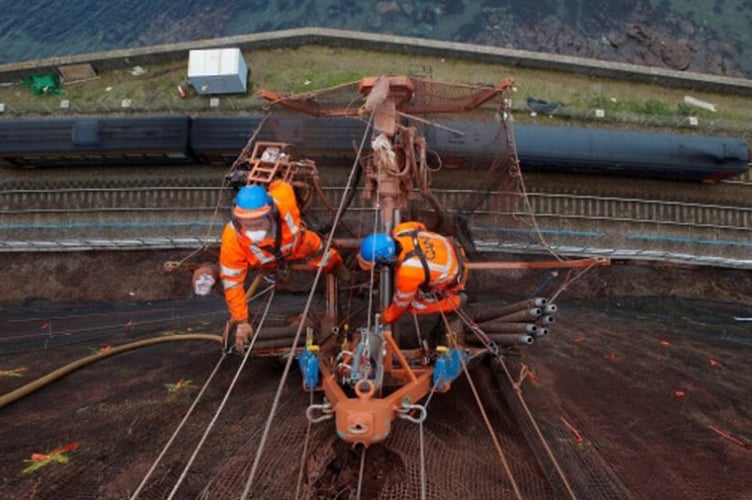
TRIAL work is about to begin in Teignmouth ahead of Phase Five of the long-running resilience programme to protect the vulnerable railway line.
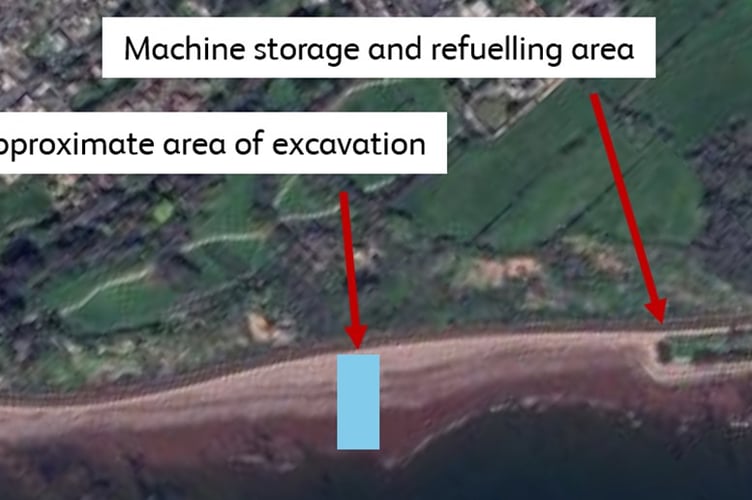
Engineers are due to move onto Teignmouth beach where they will excavate a small section of the beach to uncover a track drainage outlet.
The exploratory work will test a method of pumping water from the cliffs to see if it will help to prevent landslips.
If the trial works, it could form the future scheme to complete the fifth and final phase of the overall project.


The work starts tomorrow and is expected to last for approximately two weeks.
The drainage outlet will be investigated before the area is filled in.
The beach and coast path will remain open to the public and the work area clearly marked by red and white barriers.
Signs will be installed to warn the public to keep out of the work area as heavy machinery will be in operation.
A spokesman for Network Rail’s South West Rail Resilience Programme said: ‘We’ll excavate a three-metre-wide area to an approximate depth of 2.5 metres.
‘Sand bunds (mounds) will be temporarily created in the work site.
‘An area near Sprey Point will also be used to store our machinery and for refuelling.
‘Thanks for your patience while the work is completed. We're sorry for any inconvenience.’
Phase five of the South West Rail Resilience multi-million pound programme covers the 1.1 mile-long section of railway running along the coastline from Parson’s Tunnel to Teignmouth.
The work is part of a trial to remove water from the cliffs and will test a method of pumping water from the cliffs to assess if it helps prevent landslips.
Two wells are planned to be dug on land above Sprey Point and pumps installed to drain water from the cliffs and into the sea via a temporary pipe under the railway.
Pumping will take place round the clock for seven consecutive days for each well.
An additional bore hole will also be dug.
That and the bore holes previously dug for ground investigation work will be used to monitor how successful this method is.
If the trial proves successful at this location, a second trial could be carried out in a different location, subject to funding.
A minimum of two trials are required to prove the concept. This will guide future plans to complete phase five.
Network Rail said: ‘We are working hard to find a solution that reduces the impact on the beaches between Holcombe and Teignmouth but still provides a high level of resilience for the railway.
‘This includes an examination of what could be done if we leave the railway where it is. We are also working to reduce carbon and wider environmental impact.’
Comments
We've recently changed our login process. If you have an account for commenting, you will need to re-register on the login window.
This article has no comments yet. Be the first to leave a comment.