

A nocturnal, tree-dwelling Brazilian porcupine is the latest new resident of Shaldon Wildlife Trust, and she already has quite a fan club.
Xiorra arrived earlier this month, transferred from Papiliorama Zoo in Switzerland.
Shaldon Wildlife Trust’s director Zak Showell said: “She has absolutely won the hearts of our staff and volunteers already, and given how the announcement about her on our social media went, the public love her too.
“She is still settling in but can be seen starting to get active around 4pm when we feed her. She is a big fan of her food, particularly liking sweet potato, corn and apple.”
He said the plan is to pair Xiorra up with a male porcupine so that they can breed at Shaldon.
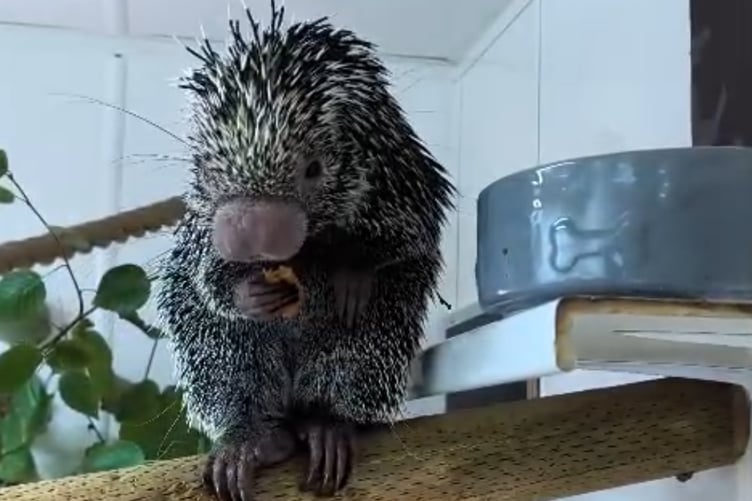
Xiorra’s species, Coendou prehensilis, is native to the tropical rainforests of South America and not currently endangered, although other related animals such as the dwarf porcupine are at risk.
As the name of the species indicates, she has a fully prehensile tail, which she can use like a fifth limb to wrap around tree branches. Some porcupines live on the ground, but the Brazilian type spend almost their entire lives high up in the rainforest canopy.
As a nocturnal animal, Xiorra spends much of the daytime time sleeping in a high-up spot.
Despite their impressive quills, they’re peaceful herbivores who eat foliage, bark, vegetables and fruits.




Xiorra was brought to Shaldon Wildlife Trust under the European Association of Zoos and Aquaria (EAZA)’s programme to maintain genetically diverse populations of species, which also fitted in with the Trust’s own institutional species plan.
Zak said: “We support several South American conservation projects, and we also like to care for rarer species. To our knowledge there are only three other zoos with Brazilian porcupines in the UK. Working with the EAZA breeding programme we will look to pair Xiorra up with a male when one becomes available.”
Comments
We've recently changed our login process. If you have an account for commenting, you will need to re-register on the login window.
This article has no comments yet. Be the first to leave a comment.