

The Chairman of Devon County Council, Cllr Des Shadrick, welcomed the numerous guests to Stover. He said Ted Hughes was ‘a colossal presence in the literary landscape’ and quoted Houseman and Shelley as well as Hughes, saying they all gave readers a sense of wonder at creation that would last a lifetime.
Carol Hughes, the elegant widow of the poet, read her husband’s Capturing Animals, a prose chapter from Poetry in the Making. In it Ted Hughes explained his early fascination with animals, how, as a boy, he would snatch mice from sheaves at harvest time, until his pockets bulged with 30 to 40 rescued mice. He came to realise that poems were a sort of animal, that they too had a separate life of their own. His first animal poem, The Thought Fox, could only exist because he had caught ‘the real fox’, and every time anyone reads the poem ‘the fox will get up out of the darkness and come walking towards them’.
Edward Chorlton, Devon County Council’s Director of Environment, Economy and Culture, explained the history of Stover, acquired by the council in 1979, when, he said, it had no facilities and a portaloo, ‘which was the main feature of primary school visits’. He praised its development, mentioned its 26 breeding types of dragonflies and informed the assembled public that the children’s poetry posts were illustrated by drawings by Raymond Briggs (author of The Snowman).



Carol Hughes unveiled the carved book that marks the start of the poetry trail outside the Interpretation Centre at Stover, and guests were offered a choice of guided tours; a short walk, ‘suitable even for those in court shoes’ or a longer walk through woodland.
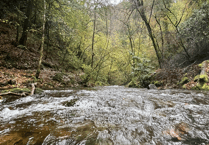
Stover basked in the sunshine, offering brimstone butterflies, the tantalising rapping of a woodpecker, newly hatched ducklings and trees dressed in the fresh and different greens of their new leaves. It also offered the poetry trail, 16 smart hard wood pillars with black granite panels bearing a variety of Ted Hughes’ poems. The poems were selected by Carol Hughes, Edward Chorlton and the Stover Rangers, and sited appropriately at Stover. ‘The Iron Man prose extract was put near the pylons,’ explained Ranger Laura Whitehouse: ‘To paint a Water Lily is near the lake, which is covered with water lilies.’ There is also a separate children’s poetry trail, with simpler animal poems. The pillars, new bridges, the poetry chair and various carved animals were produced by Greenspace Designs of Okehampton, by sculptor Mick Chamber and etcher and craftsman Tom Hills.
Greenspace and the Stover Rangers were helped in their work by Carol Hughes’ gift of a Kubota tractor. ‘It was a way of saying “Thank you” to them,’ she explained. ‘They pulled their trailer by hand and used wheelbarrows before, but I though they needed help with transport. They call it their workhorse now.’
Carol Hughes first met her husband when she was a 17 year old A level student, studying his poems. He knocked on the door of her parents’ North Devon farmhouse to introduce himself one day after he’d been fishing in a nearby pond. Carol trained as a nurse before she agreed to marry him when she was 22: Ted Hughes was 40. His first wife was poet Sylvia Plath, who died in 1963. ‘Ted would have been very pleased by the Stover Poetry Trail,’ said Carol Hughes: ‘He was so much a man of the countryside.’
Comments
This article has no comments yet. Be the first to leave a comment.