
.jpeg?trim=0,0,3,0&width=752&height=500&crop=752:500)
Pine martens, reintroduced on Dartmoor in 2024, have bred for a second year.
Film footage captured by local residents shows a mother and two offspring – known as kits - on land near the Wray Valley.
Meanwhile, another film clip has offered the first proof that pine martens released on Exmoor as part of the same project are also breeding.
The Devon Wildlife Trust, which is leading the project, said the footage is evidence of its success in bringing the endangered animals back to the south west of England.
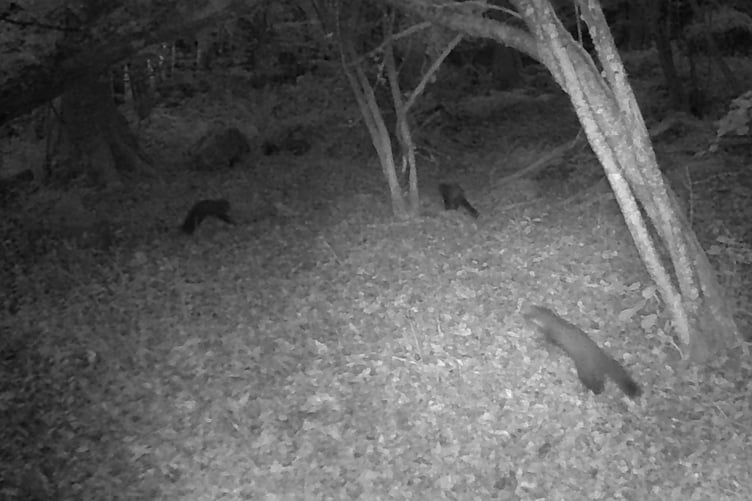
The Dartmoor film was captured on a trail camera by residents Tim and Rachel, who said: "Since moving to the Wray Valley last year, we have been extremely lucky, as we have managed to capture quite a few trail cam videos of pine martens in the woods behind where we live.
“We’ve only ever filmed a single one at a time, so we couldn't believe our eyes when we downloaded this video of a mother with her two kits playing alongside her.
“We feel very fortunate to have experienced this sighting and so glad to see the success of the Two Moors Pine Marten Project!”
The project is the first attempt to re-establish a sustainable breeding population of pine martens – tree-climbing members of the weasel family – in the south west since they were hunted to extinction more than 100 years ago.
It’s part of a national strategy to restore pine martens across England and Wales.
-jpg.jpeg?width=209&height=140&crop=209:145,smart&quality=75)


In 2024 the Two Moors Pine Marten Project reintroduced 15 pine martens in secret locations on Dartmoor. A further release of 19 pine martens followed on Exmoor in 2025.
Since their release the pine martens in both locations have moved around a lot and proved very shy of human beings.
But in July 2025 the project recorded clips of a female and her offspring on Dartmoor, confirming that breeding had taken place there.
The Exmoor footage, filmed this year, captures the moment when a female pine marten and her four kits visit a trail camera baited with peanut butter and fish oil – a combination of smells and tastes which pine martens find irresistible.
But the project to restore pine martens is still at an early and fragile stage.
Daniel Brown, the project’s field officer for Dartmoor, said: “Pine martens live at low density – meaning there aren’t many of them around, even when they become established in a landscape.
“They are also slow breeders - giving birth to just one litter each year. This means their population growth is only gradual.
“This makes their populations vulnerable to losses in road accidents, while trapping and poisoning are also a threat.
“The vulnerability of the species means we’re very keen to hear from people who see pine martens in Devon, Cornwall or Somerset.
“Sightings are vital in helping us track the progress of these elusive animals and landowners with trail cameras may also like to take part in our Citizen Science Woodland Survey.”
Contact details for the project, along with more information about pine martens, can be found at www.twomoorspinemartens.org
Comments
This article has no comments yet. Be the first to leave a comment.