
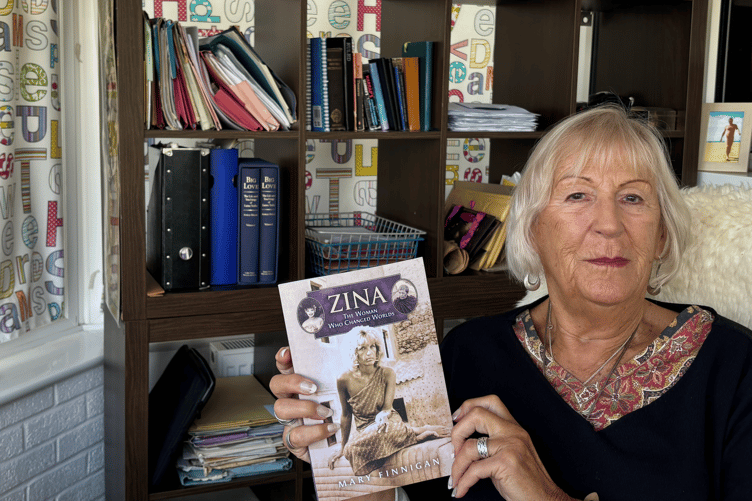
AN 88-year-old author who had David Bowie as her lodger in the late 1960s has published the extraordinary story of a woman who helped introduce Tibetan Buddhism to the West.
Mary Finnigan, who lives near Newton Abbot, met Bowie when he was still a little-known young musician looking for work in London clubs. He lived with her for about a year and, she says, played an important part in her own spiritual journey.
It was Bowie who introduced Finnigan to Tibetan Buddhism — an interest which eventually took her to Nepal, where she met Zina Rachevsky, the subject of her new book, Zina: The Woman Who Changed Worlds.
Finnigan was working as a journalist in London when Bowie became her lodger in the late 1960s.
‘He directed me to Samye Ling’, she said, referring to the Tibetan Buddhist centre in Scotland.
‘I had some contact with Tibetan Buddhism, but not with any lamas’.
A short time later, Finnigan travelled to India and Nepal with a friend from London.
The two had been part of the psychedelic scene of the 1960s, but were looking for a different way of exploring consciousness.
‘We were both basically refugees from the psychedelic era in London’, Finnigan recalled.
Their journey eventually led them to Kopan, a remote hillside outside Kathmandu, where they encountered Rachevsky and two Tibetan Buddhist teachers, Lama Thubten Yeshe and Lama Zopa Rinpoche.



Rachevsky was an extraordinary figure.
Born into a wealthy Russian émigré family, she had lived a glamorous life as a socialite and actress, appearing in films in Europe, before turning her attention to Buddhism.
At Kopan, she helped create a meditation centre aimed at Westerners at a time when Tibetan Buddhism was still largely unknown in the West.
When Finnigan arrived in 1970, the centre was in its infancy.
‘It was absolutely extraordinary’, she said.
‘We were very, very lucky because we were in there right at the beginning’.
Finnigan remembers living in a simple mud-brick house on the hillside, surrounded by an almost untouched landscape with panoramic views of the Himalayas.
Describing Rachevsky, Mary said: ‘She was very impressive from the moment that I met her - very charismatic, very penetrating, wise’.
But Rachevsky’s vision for the centre eventually diverged from that of the Tibetan teachers.
She envisaged an artistic and creative community where Western bohemians could combine meditation with their interests, while the lamas wanted to establish a more traditional monastery and school.
Rachevsky eventually left Kopan and went into retreat at a remote monastery in the Himalayan region of Solukhumbu.
She became seriously ill and died in 1973, aged just 43. The precise cause of her death remains unknown.
Finnigan had been given a typescript of Rachevsky’s memoir before she returned to Britain, but the material remained largely untouched for decades.
In 1994, she decided to track down people who had known Rachevsky, travelling around the world and recording interviews on cassette tapes.
She interviewed people in the United States, New Zealand, Australia, Thailand and Nepal, gathering accounts of Rachevsky's life and her final days.
It was not until after the Covid pandemic, however, that Finnigan finally began writing the book.
A former newspaper and broadcast journalist, she says her career taught her to write concisely, but producing a full-length biography required a different approach.
The result is her third book, and Finnigan says it will also be her last.
‘I’m 88, you know’, she said. ‘I really don’t feel like stretching myself’.
Zina: The Woman Who Changed Worlds is available online via Amazon
Comments
We've recently changed our login process. If you have an account for commenting, you will need to re-register on the login window.
This article has no comments yet. Be the first to leave a comment.