

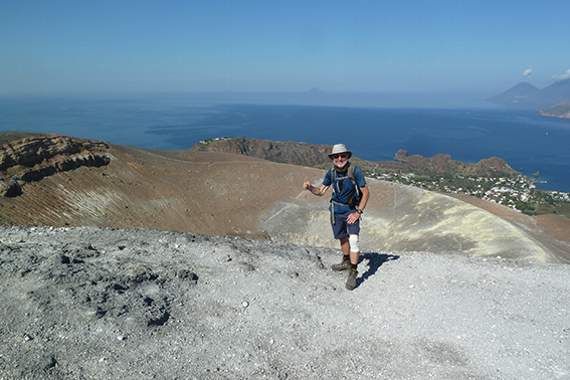
Norman Maudsley writes: I am reminded of a statement made to me during a recent vote of thanks following one of my many
illustrated talks which support our air ambulance here in Devon.
It went: ‘When I have seen your previous adventures I thought you were mad. Now I am convinced you are!’
Personally I do not think so. What I do know is that life is for living, and the certainty is that when you are dead you are dead.


Which leads me to report on my recent trip away to climb the Sicilian volcanoes around the Aeolian Islands off the toe of Italy.
I was not disappointed, having travelled out via Heathrow and Rome to Cataina Airport in Sicily, where I met up with the walking group leader Lea Fazio and the other members of our party, who had travelled from the UK, Australia, USA and Israel.
We were still three hours away from our first overnight accommodation. First a 90-minute coach ride took us up the stunning road along the east coast of Sicily, with views out over the beautiful blue Mediterranean sea. The road wound along the twisting coastline and passed through lots of tunnels before we arrived at the Milazzo. Here we took in some fluids and awaited our onward connection, the first of numerous catamarans which would transport us around the stunning Aeolian archipelago.
After a bumpy crossing of the Mediterranean at high speed we arrived at Lipari with its archaeological ruins and lively harbour, one of the biggest and most beautiful of the Aeolian islands.
Finally we settled into our hotel where, after a good night’s sleep, our real adventures were to start in the morning.
After a typical continental breakfast we sailed across the cobalt waters to the island of Vulcano, one of several Aeolian islands, famous for its long black beaches and bubbling thermal springs.
Our climb took us up rough basalt and crushed volcanic rock to Vulcano’s crater rim at 390m above sea level to see steaming fumaroles venting volcanic gas with its pungent smell of rotten eggs, through holes and cracks in the surrounding rocks.
Making our way back down to sea level we bathed in Vulcano’s hot springs and grey mud baths, leaving our skin feeling as smooth as a baby’s bottom. After a swim in the warm Mediterranean, still smelling of the sulphur we needed a shower before getting back into our walking gear to make our way by hydrofoil back to Lipari for our evening meal and overnight stay.
The following morning we had an easy hike to the north coast of Lipari, to climb 300m to a wonderful view over an ancient crater, formed after a volcanic eruption in AD700. We then crossed fields around the crater which are renowned for their pumice deposits and obsidian flows (a dark, glassy rock).
In the afternoon we walked over to the south coast of the island, which offered stunning views over Vulcano’s main crater.
The next day we were out on the Mediterranean again to travel to the island of Stromboli, famous for being one of three active volcanoes in Italy and an interesting place for geologists and tourists to explore .
After offloading our gear we had time for some of us to laze on the black sandy beach or swim in the Mediterranean while others explored around the town and local area.
Our main event of the day was a pre-sunset walk to the western side of Stromboli with a 400m climb to the spectacular Sciara del Fuoco – a fiery channel where the lava outflows can sometimes plunge directly into the sea. It was not to oblige tonight. However, all was not lost as we enjoyed a spectacular sunset before heading down to enjoy an evening meal in a popular pizza restaurant, renowned for its view of Stromboli’s fiery explosions.
Over our evening meal it did oblige three times. Luckily there were plenty of diners so everyone knew to look up when a shout went up.
Just leaving a four kilometre walk back to our hotel in the dark.
The next day there was a chance to explore the town of San Vincenzo. Later we trekked to the summit of Stromboli at 942m to arrive just before darkness fell.
Our hope on this occasion was that the crater would be more active than the previous night. We peered into its deep craters while wearing safety helmets, goggles and face masks, with steam floating above the crater forming a cloud-like filter.
There were some small explosions and numerous explosive booms, but nature did not perform any spectacular scenarios on this occasion. So, wearing head torches, it was a return trip back down a very dusty 6km trail to our hotel.
The following day we were due to leave the island on a lunchtime ferry but the weather forecast indicated a storm was on its way. A decision was made to rise early to sail at 6.30am.
Awaking on yet another glorious sunny day it was time to leave Stromboli. We took the boat ride back to Milazzo and transferred to a pretty mediaeval town of Castelmola.
After a short walk we reached the elegant town of Taormina with time to visit the town’s Greek theatre. Originally built in the third century BC it is still used for performances during Taormina’s annual summer arts festival. There was time to explore the shops for presents or, as I did, sample some of the excellent gelato, during which a tremendous storm hit the town.
We then headed up to 1,900m from where we enjoyed great views over the Mediterranean and the east coast of Sicily and reached our lodge which is located close to the most recent lava flows.
With time to spare before our evening meal I decided to explore a large crater close by the lodge. As I climbed up to view inside, a furious wind got up and I had to take refuge behind a large rock. With the wind gusting I kept low till it eased, then abandoned my thoughts of looking into the crater and made a dash down to lower ground. It was then that I came across another interesting feature of this spot.
A pyramid shaped information panel was sitting on the first easterly meridian – a circle of constant longitude. This meridian is lying at 15 degrees east of the Grenwich meridian. The next day we faced the Mount Etna Challenge. Not having time to walk the full distance we went first by cable car then four-wheel drive to the start of our walk at 290m above sea level.
Numerous craters have spewed out lava for thousands of years, making the area the second most active volcanic area in the world, beaten only by Guatamala.
I was surprised to see thousands of ladybirds everywhere.
The volcanic area covers several square miles and is a fascinating place to visit – well worth the effort involved in getting there.
On our visit the fumaroles were working overtime spewing out sulphur gas. Coughing and spluttering we were advised to leave the area and start our descent.
We followed a more direct route down the screes of volcanic ash, allowing those among us who were brave enough – or mad depending on your own personal view– to run down the mountain, plunging our feet heel-first into the ash making good time down the long slopes. Great fun!
Now on a lower contour we then had a further walk to take us up to walk along the rim of the Bove Valley, an extensive depression that opened up thousands of years ago as a result of a massive landslide.
Now much lower than where we had started walking, it was time to head back to the cable car.
Packed up and ready to leave, we headed out into Catania to enjoy a farewell meal as a group before heading back to the hotel for our last night on Sicily.
Back at Heathrow after a flight from Rome with bags collected, I headed home to Devon, arriving in Exeter at 4am.
An excellent holiday with lots of photographs, it only remains for me to put together yet another interesting talk to raise funds for the Devon Air Ambulance Trust.
Hopefully you good readers will meet me somewhere along the line at one of my fundraising events.
Comments
This article has no comments yet. Be the first to leave a comment.