

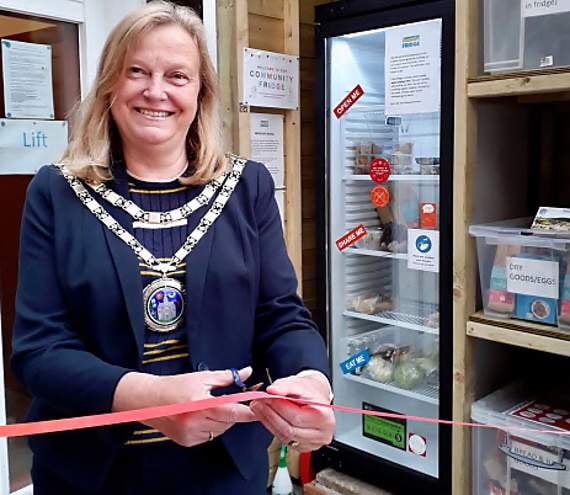
Ashburton Community Fridge started operating a few weeks ago and has already become a very popular feature of town life.
Community fridges reduce food waste by taking food that would otherwise have been thrown out from shops, wholesalers and private individuals.
The food is placed in the fridge which is in a publicly accessible spot – in Ashburton it is behind the Town Hall and directly opposite the car park – and members of the public can come by and take what they need.


.jpeg?width=209&height=140&crop=209:145,smart&quality=75)
In Ashburton the fridge is open 24/7, although others around the country (there are hundreds in the UK) are located in buildings such as libraries or churches so have more restricted opening hours.
A team of 31 volunteers keeps the fridge running smoothly. Some are responsible for regular cleaning of the fridge and checking that the contents meet the criteria (no meat or fish, no opened packages, nothing cooked in a private kitchen) and are still of good quality. Others do regular runs to local shops or supermarkets further afield to collect food that has been removed from their shelves.
Fridge founder Inga Page said: ‘We’ve had a wonderful response from the town – we have a fantastic group of volunteers, a small and dedicated core group who coordinate and publicise our activities and lots of support from the members of the public who take away and consume vast quantities of broccoli, bananas, bread and a lot of other more unusual items!’
The idea of a Community Fridge began with the formation of Ashburton Climate Emergency (ACE), when the Food group identified this as a good way to reduce the carbon emissions associated with food waste.
Ashburton Town Council helped kickstart the project by providing space for the fridge by the Town Hall and the all-important electricity supply.
Funding from a variety of organisations paid for the shelter, signage and cleaning supplies.
After the official ribbon cutting, ACE had a stall in front of the Town Hall giving out information about the fridge as well as plants to encourage people to grow their own food: alpine strawberries and perennial (walking stick) cabbage plants.
The next step for the ACE Food group is to create containers for edible plants around the town, to support the planting of fruit and nut trees on public spaces and – when conditions permit it – to start running cookery workshops showing interesting ways to prepare the surplus food that most frequently appears in the fridge.
Comments
This article has no comments yet. Be the first to leave a comment.