

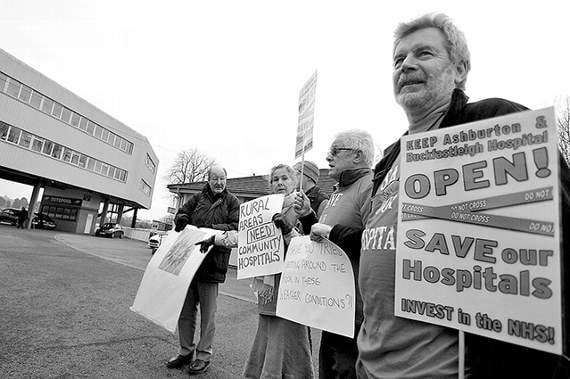
HEALTH chiefs duly made their ‘difficult decision’ on Thursday to close four community hospitals in South Devon, two of them in Teignbridge.
Nearly 120 vociferous opponents of the measure - affecting Ashburton, Bovey Tracey, Paignton and Dartmouth - made their feelings felt during the frequently interrupted two-and-half-hour debate and presentation by the governing body of the Clinical Commissioning Group.
There was standing room only at Newton Abbot Racecourse’s Teign Suite as CCG members ended three-and-a-half years of public debate over the contentious issue.
The meeting’s chairman, Dr Derek Greatorex, said at the momentous conclusion: ‘It’s been a very difficult decision for the CCG to make. It’s been challenging - but that is part of the process we’ve had to go through.



‘It’s the best way forward to meet the needs for our local population with the resources we have available to us.’ He said the next step now was ‘implementation’ of the closure recommendations - although no exact timetable of who goes where and when was not disclosed at the packed meeting, which was open to those members of the public who asked to attend.
CCG spokesman Simon Tapley revealed that it was unlikely the hospitals would close simultaneously - but it was likely that the all-change would be underway within months. But that would only happen once the systems of the ‘new model of care’ were in place to the CCG’s satisfaction.
‘We are confident our proposals will meet the local health needs,’ he insisted. Ashburton and Buckfastleigh Hospital emerged with the least scars with health managers agreeing to consider using the building as a ‘health and wellbeing centre’ in the hope local GPs would be a part of the new regime. Bovey Tracey and its beds will be no more, although it has been temporarily closed since the end of 2015.
The meeting was told that nearly 70 staff had been recruited to bolster interim care provision in anticipation of a more home-based health service across Teignbridge and the rest of South Devon. The CCH conceded that the ‘majority’ of people who responded to the consultation process over closures wanted their hospitals to stay open.
‘The feelings were very strong,’ Mr Tapley admitted. He also recognised the ‘conundrum’ which emerged during the debates to the effect that people wanted health services strengthened - but did not want to be admitted to hospital or stay too long if they were.
‘We don’t have the staff or the funds to keep our current community hopsital beds,’ he told the meeting. Retired consultant David Halpin from Haytor, in a submitted question to the governing body, suggested the health service did not have adequate resources to operate their ‘care in the home’ initiative.
‘And if your plans implode, which is likely, will you walk away - with or without any pensions accrued from the CCG?’ he asked. Dr Greatorex confessed that recruiting staff for community hospitals had been difficult - but with alternative health care provision it was easier to attract new staff encouraged by better career options.
‘They will be able to cope with more resilient staffing arrangements,’ he said. He did not think the new system would implode. The CCG was, he argued, making the best of the resources available to it.
‘We are committed to improving the care of the people we serve,’ he stressed. Totnes MP Dr Sarah Wollaston, chairman of he Commons Health Committee, was invited to speak at the meeting. She revealed that, as a former member of staff at Moretonhampstead Community Hospital, she recognised what special places they were - particularly in providing end-of-life care. She accepted that no one wanted to see any hospitals close. The CCG, she maintained, had difficult decisions to make doing a very tricky job where money was an object.
‘It’s not just a job about the NHS but social care and how the whole system works holistically together,’ she observed. She repeated the call for health chiefs to make sure all the care models were in place before implementing the hospital closures. Dr Matt Fox, who helps run Teignmouth and Dawlish’s health care service, said he was confident the new-look medical landscape would fit in.
We are doing in Teignmouth and Dawlish what we thought we would be able to do. It’s been overwhelmingly positive. We are delivering care for all the people instead of just a small percentage,’ he said. Dr Nick Roberts, CCG chief clinical officer, said after the meeting: ‘Evidence locally and nationally shows that supporting people in or near their own homes provides more effective outcomes for many patients, and this has to be one of our key priorities.
‘Some £5.1million is being invested in health and wellbeing teams, which will bring together nurses, physiotherapists, occupational therapists and social care support to look after people closer to home. “We believe that these changes will meet the demands of our modern society - but I want to stress that high-quality hospital care will still be available when needed for patients. That’s essential.’
Comments
This article has no comments yet. Be the first to leave a comment.