

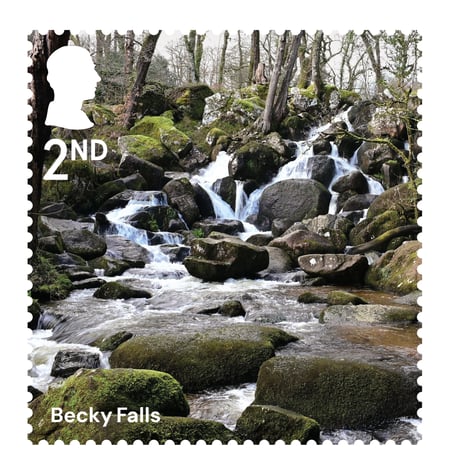
A FAMOUS Teignbridge waterfall is to featured on a new set of stamps unveiled today by Royal Mail that showcase some of the UK’s most enchanting and spectacular waterfalls.
Becky Falls is one of 10 stamps in the set feature photography of waterfalls from all four nations of the UK, capturing the power and beauty of some of our most dramatic natural landscapes. Becka Brook is a tributary of Dartmoor’s River Bovey, located in ancient oak woodland that is home in springtime to bluebell displays.
Just before entering the river, the brook tumbles 20m down a boulder-filled section of the side valley.
It splits many times as it flows between the enormous, moss-clad lumps of granite spread across the 10-metre-wide channel.




Other waterfalls shown on the stamps are: Rogie Falls, Pollnagollum Cave, Aysgarth Falls, Pistyll Rhaeadr, Hardraw Force, Rhaeadr y Graig Lwyd / Conwy Falls, fairy pools of Glen Brittle, High Force and Ess-na-Larach.
David Gold, Director of External Affairs and Policy, Royal Mail, said: ‘The British Isles are rich in natural beauty and these stamps highlight some of the UK’s most striking waterfalls in all four nations.
‘They showcase the richness of our natural environment which has been shaped by water over thousands of years.’
Paul Richards, owner of Becky Falls, said: ‘It is a real privilege to see Becky Falls featured on a Royal Mail stamp as part of this wonderful celebration of the UK's most spectacular waterfalls.
‘It is a fantastic opportunity to showcase one of Devon’s most beautiful natural attractions and introduce even more people to this special place.
‘As a Site of Special Scientific Interest, conservation is at the heart of everything we do.
‘Having the falls recognised in this way is a proud moment for everyone connected with Becky Falls. We hope this recognition will inspire more people to discover Becky Falls, helping us continue to protect and preserve its unique natural beauty for generations to come.’
Waterfalls are among nature’s most awe-inspiring spectacles: an explosion of power as a river suddenly loses height.
Many of the falls found in the UK are the result of differential erosion of horizontal bands of rock – where an upper, harder rock type withstands the erosive force of the water but a lower, softer layer is steadily worn away, creating a point where the river has to ‘step’ down.
In some places, glaciation has created hanging valleys, which act in a similar way, causing watercourses to plunge over their edges.
Variations in rock types and geological processes mean that no two waterfalls look the same.
The names given to waterfalls often reflect their location, including ‘force’ (from the Old Norse ‘foss’) in the north of England, ‘rhaeadr’ in Wales and the Gaelic word ‘eas’ (or ‘ess’) in Northern Ireland and Scotland.
The stamps, and a range of collectible products, are available to pre-order from June 18 at www.royalmail.com/waterfalls and by telephone on 03457 641 641.
The stamps go on general sale from 23 June.
Comments
This article has no comments yet. Be the first to leave a comment.