

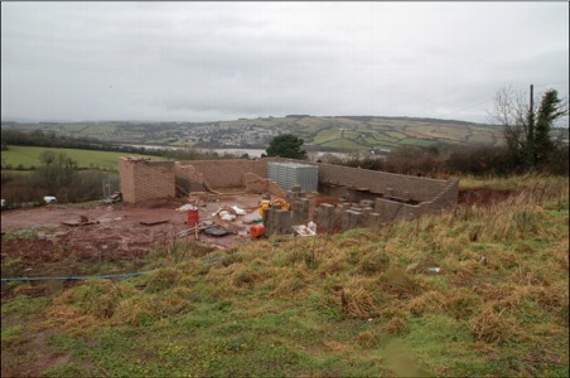
A smallholder has been jailed after he used a stable block as cover for a massive secret cannabis factory in an underground bunker.
Steven Loveridge built high walls and gates around his land at Shaldon, kept a fierce guard dog on the site and warned off passers-by with signs on the gates.
He used 275 tons of cement to construct the bunker, which was invisible from ground level and could only be reached through a shipping container which held a secret staircase.
Loveridge hired two friends to help run the enterprise, one of whom was a pensioner who he paid £30 a week to live in a caravan on the field and feed the guard dog.




He planned to make up to £94,000 every four months from the secret hydroponic operation and had already bought two jetskis and started renovating his home in anticipation of the profits.
Henchman Clive Platt-Lea was caught red-handed when police raided the field at Long Lane, Shaldon, and found him tending the plants in the bunker.
The third member of the team was 70-year-old Christopher Kerr. He was found above ground by photos on his camera showed cannabis growing and the scheme in different stages of construction.
Loveridge had previous experience of cannabis growing and had spent £12,000 on hydroponic kit. He had a power supply installed which he by-passed to avoid paying the bill or arousing suspicion.
He was jailed for six years by Exeter Crown Court after a Judge said he would have carried on the large-scale production of cannabis indefinitely unless he had been caught.
Loveridge, aged 38, of Langford Crescent, Torquay, Platt-Lea, aged 52, of Colley End Road, Paignton, and Kerr, of Oxlea Road, Torquay, all admitted conspiracy to supply cannabis.
Loveridge was jailed for six years, Platt-Lea for three years and eight months, and Kerr for 16 months, suspended for two years by Judge Francis Gilbert, QC, at Exeter Crown Court.
The Judge told them: ’The police came upon a highly professional, well planned, commercial operation for growing cannabis in an underground bunker on this small field in Shaldon.
’In the bunker there were 136 plants capable of producing a crop worth between £67,000 and £94,500 and weighing 9.41 kilograms. All the usual equipment was there; heaters, lights, ventilation, and so on.
’The bunker was beneath a partially constructed five-stall stable and electricity had been run underground. The activity was hidden behind the high walls of the stables and you had a large and fierce looking guard dog.’
He continued: ’There had never been any intention to keep horses at the stables and the building was there specifically to disguise what was happening beneath.
’It must all have cost at least £25,000 in materials and construction and it was obviously not intended for a single, one off cannabis grow. It was the intention to carry on growing until it was found by the police.’
Peter Coombe, prosecuting, said Loveridge bought the land in 2009 and obtained planning permission for the stables. He said it is likely that the nearly-mature crop found by the police in December 2012 was the first.
Documents seized showed 275 tons of concrete had been delivered, although Loveridge never paid for it, and £12,000 was spent buying hydroponic kit at a shop in Taunton.
Phone records showed Loveridge visited the field hundreds of times and the photos found in Kerr’s camera showed both the cannabis growing and the work being carried out at Loveridge’s home.
Loveridge had not paid any tax and was supposedly living on benefits, but was having extensive work done at his home and he and Platt-Lea had just bought expensive jetskis.
Stephen Vullo, QC, for Loveridge, said others were involved at a higher level and he was not the Mr Big. He said his client had run a successful building business and is now involved in starting a recycling company.
Paul Dentith, for Kerr, said he had been homeless when he was offered a chance to live in a caravan on the land, where he was paid a small amount for keeping an eye on the field. He is in poor health and would lose his assisted accommodation if sent straight to jail.
William Parkhill, for Platt-Lea, said he has never been in trouble before and foolishly agreed to help a friend. At the time his marriage had broken up, he had lost his job, and his home had been repossessed.
He said much of the case had been based on meticulous records kept by Platt Lea and added: ’It is clear he was not suited for a criminal lifestyle. That is shown by the way he kept records.’
Comments
This article has no comments yet. Be the first to leave a comment.