

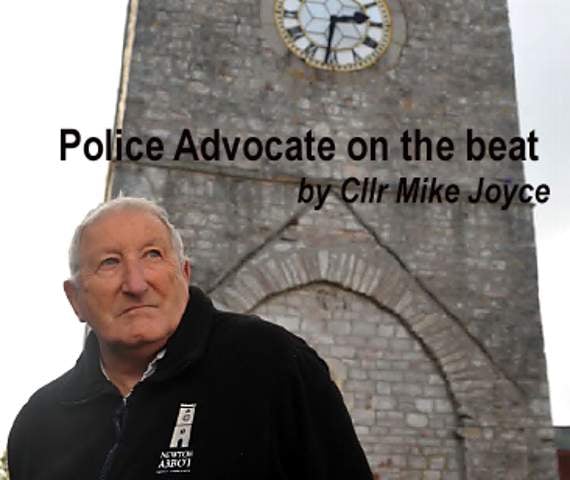
As a councillor I am sometimes asked what a Community Service Order achieves.
Some people are left with the opinion that those who have transgressed are let off the hook without carrying out the tasks they were assigned.
Well, I’m reliably informed that there are in fact several projects locally that the Community Payback scheme is involved with and which actively engage offenders.
Bear in mind that the initiative covers the whole of South Devon, it is not surprising that the visibility in and around our town is not always that high.


What’s more, for obvious reasons, the projects are not always publicised. Despite this lack of public awareness however, the work carried out is appreciated and worthwhile.
What is also not so well known is that projects do not always involve groups but are designed for individuals.
For example, right now there are charity shops within our area benefiting from the contributions of people serving Community Service Orders, some much needed support at this critical time.
Colleagues in the probation services have been kind enough to provide some details on Community Payback, what it is designed to do and what it achieves.
Dorset, Devon and Cornwall Probation Services has been part of Kent, Surrey and Sussex Community Rehabilitation Company (KSS) since February 2019.
KSS is operated by Seetec, an employee-owned company in the UK.
However, change is coming as I was advised that under an imminent reorganisation the Community Payback Scheme will soon be operated once again by the National Probation Service.
The scheme is aimed at help offenders change their lives for the better and reduce reoffending.
Courts can sentence individuals to as much as 300 hours of unpaid work which must be carried out a rate of at least seven hours a week, more if they don’t have a job.
Community Payback provides:
? Punishment – challenging and demanding work which acts as a visible punishment and deterrent
? Reparation – a way service users can pay back local communities that suffer as a result of crime
? Rehabilitation – the opportunity for service users to make a positive contribution to the local community and develop skills that will help them find work.
A supervisor oversees the work of service users on projects and up to 20 per cent of the unpaid hours can be used to help individuals attend employment-related training or education.
Each year more than 125,000 hours of Community Payback work is completed by people on probation. This is the equivalent of almost £1 million based on the average minimum wage for people aged 18 and above.
So there you have it.
Like so many schemes before this, or indeed probably yet to be devised, Community Payback does its best to ensure that those who have been asked to repay the community for their actions are not getting off lightly.
They are, in fact, being reminded that they are responsible for their actions and that those actions have consequences.
Do you know of a project that might be considered by the Community Payback scheme?
They are always open to suggestions and willing to consider anything that will assist the community, no matter how large or small.
They would welcome contact from groups or individuals with ideas or suggestions.
Write to: CP Manager, DDC Probation Services, First Floor, Union House, Union Street, Torquay, TQ1 3YA.
One final point, as a youngster growing up in Okehampton, my mum used to take me on coach trips across the moor and she would point out the work gangs from Dartmoor Prison who were repaying society by repairing stone walls, clearing ditches or filling in potholes.
Community Payback may be a new method of working but it’s nothing new to society.